For decades, dressing well was a consequence. A way of being in the world shaped by context, profession, environment and, above all, use. Clothing accompanied life. Today, the opposite happens. Life adapts to clothing. Every garment seems to exist to be observed, photographed and validated, not to be lived in.
The obsession with perfection has turned men’s style into something excessively controlled. Everything matches, everything aligns, everything is measured down to the last detail. Proportions are exact, colours carefully calculated, silhouettes clean. And yet, something has been lost along the way. Naturalness. Imperfection as character. The sense that there is a person behind the clothes, not just an aesthetic exercise.
The problem is not dressing well. The problem is trying to do everything too well.
The “perfect outfit” as an artificial construction
Social media has changed the way men relate to their image. The outfit is no longer a spontaneous result, but a project. It is built to be seen, not to be worn. Every combination follows an immediate visual logic, designed to work in a static image rather than in a real day.
This approach produces a polished, impeccable aesthetic, but also a fragile one. Everything depends on nothing being out of place. A crease breaks the harmony. A marked shoe ruins the look. A worn garment no longer fits the visual narrative.
Style becomes rigid, almost clinical. And when that happens, it loses its humanity.
Elegance is not symmetry
There is a growing confusion between elegance and perfection. As if dressing elegantly meant eliminating every trace of wear, use or improvisation. But masculine elegance has never worked like that.
True elegance does not come from absolute symmetry, but from balance. And balance allows irregularities. A jacket softened by time. Trousers that fall differently because they have adapted to the body. A coat that shows signs of having accompanied many winters.
For years, we have been taught to fear wear. To care for garments as if they should remain untouched forever. Yet in classic menswear, patina has always been a value. A sign of continuity, coherence and a lasting relationship between a man and his wardrobe.
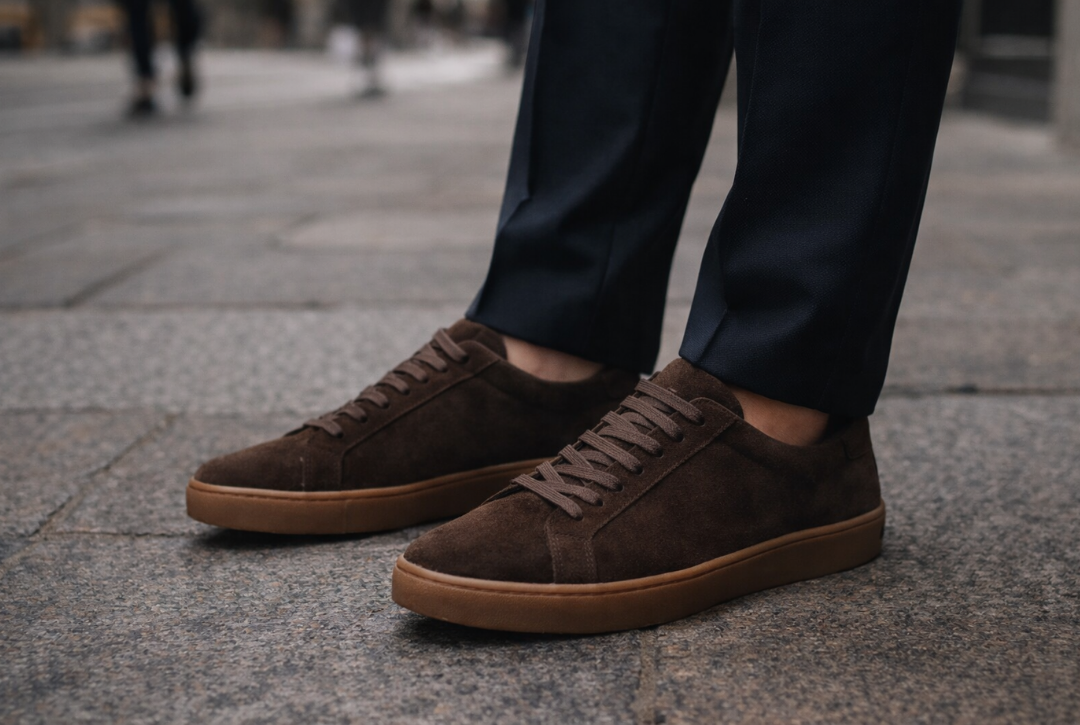
The natural creasing of a cotton shirt, the subtle shine that appears on well-maintained shoes, the texture a jacket acquires over time are not flaws. They are layers of identity. They speak of habits, repeated gestures and real life.
When everything is new, when everything looks recently bought, style becomes impersonal. It belongs to no one.
The contemporary fear of looking imperfect
Part of this obsession with perfection comes from fear. Fear of getting it wrong. Fear of not fitting in. Fear of not meeting an imposed visual standard. Contemporary menswear has, paradoxically, created more insecurity than freedom.
Men dress to comply, not to express. To avoid mistakes, not to feel comfortable. And when getting dressed becomes a constant source of tension, it stops fulfilling its essential purpose.
Dressing should be intuitive, not an aesthetic audit.
Reclaiming style as an experience
Perhaps the truly elegant gesture today is allowing clothes to age with you. Accepting that not everything needs to be perfect. That style is not a frozen image, but a narrative in motion.
Perfection may impress. But it never moves us. And style, when it is authentic, should always say something deeper than “everything is in place”.